How Inflation Is Quietly Making You Poor
Ask most salaried Indians if they’re “doing fine” financially, and they’ll point to their payslip. Their salary went up 8% this year. They got a promotion. Their bank balance looks healthy. By every visible measure, things seem okay.
And yet, somehow, it never feels like enough.
The grocery bill is higher. The rent renewal came with a nasty surprise. That vacation you’re planning costs 20% more than it did two years ago. You’re earning more than ever — so why does it feel like you have less?
The answer has a name: inflation. And it is one of the most underestimated forces quietly draining the wealth of millions of salaried professionals in India — without a single rupee being “stolen” from their account.
This blog breaks down exactly how inflation makes you poorer even when your income is rising, why your savings account is a silent loss-maker, and what you can actually do about it.
What Is Inflation, In Plain English?
Inflation is simply the rate at which prices for goods and services rise over time — which means the same amount of money buys you less than it used to.
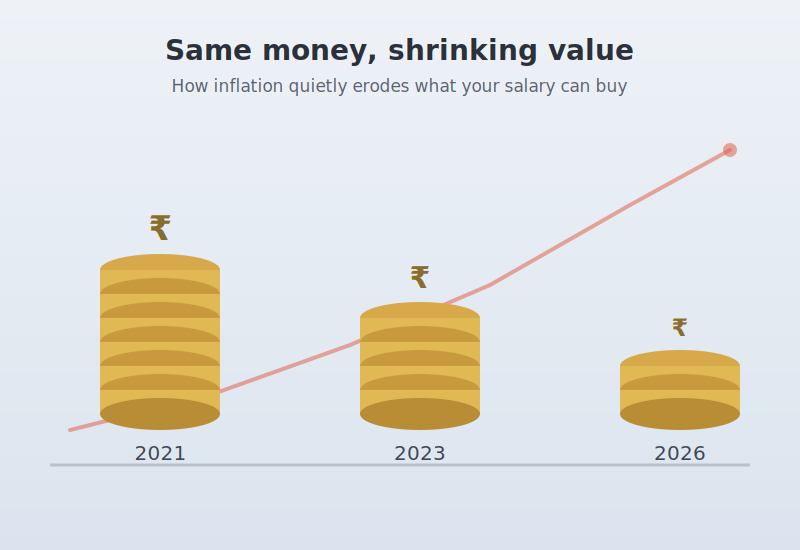
If inflation is running at 6% a year, something that cost ₹100 today will cost ₹106 next year. Your rupee hasn’t changed. Its purchasing power has.
This is the part most people miss: inflation doesn’t take money out of your bank account. It takes value out of the money that’s already there.
How Inflation Makes You Poor Without You Noticing
1. Your Salary Hike Might Be an Illusion
Let’s say you got a 7% salary hike this year. Sounds great — until you realize inflation was running at 6%. Your real income growth? Just 1%.
This is the single biggest blind spot in personal finance: people track nominal income (the number on their payslip) instead of real income (what that number can actually buy). A rising salary that doesn’t outpace inflation isn’t growth — it’s a treadmill.
2. Your Savings Account Is Losing Money Right Now
Most savings accounts in India offer 3–4% interest. If inflation is at 6%, your money is losing roughly 2–3% of its real value every single year — even as the number in your passbook keeps climbing.
You’re not accumulating wealth. You’re watching it evaporate in slow motion, dressed up as “safe” saving.
3. Fixed Deposits Aren’t as Safe as They Feel
FDs give a comforting sense of security, and they have their place. But once you account for inflation and taxation on the interest earned, many FDs deliver a negative real return. You’re technically earning interest — and technically getting poorer at the same time.
4. Lifestyle Costs Rise Faster Than Headline Inflation
Government-reported inflation (CPI) is an average across many categories. But look closer:
- Education costs and school fees often rise 10–12% a year
- Healthcare costs and health insurance premiums climb well above headline inflation
- Rent in urban India frequently outpaces the official inflation number
This is why people earning more than ever still feel financially squeezed — the inflation that affects your specific life is often much higher than the number in the news.
5. It Delays Your Financial Goals Without You Realizing It
That retirement corpus you calculated five years ago? At today’s prices, it’s probably insufficient. That house down payment goal? The target has quietly moved further away. Inflation doesn’t just erode what you have — it moves the finish line for what you need.
Why This Goes Unnoticed for So Long
Inflation is invisible on a day-to-day basis. Nobody sends you a notification saying “you lost 6% of your purchasing power today.” It shows up only when you compare things across years — a habit almost nobody builds naturally.
Combine that with salary hikes, bonuses, and promotions creating a false sense of progress, and you get an entire generation of salaried professionals who feel like they’re winning financially while quietly losing ground.
How to Protect Yourself From Inflation
1. Stop Measuring Wealth in Nominal Terms
Start asking “what can this money actually buy?” instead of just tracking the number.
2. Move Beyond Savings Accounts and Low-Yield FDs
Idle cash beyond your emergency fund needs to be working harder than inflation, not losing to it.
3. Consider Growth-Oriented Investments
Equity mutual funds, index funds, and other growth assets have historically outpaced inflation over the long term far better than fixed-income instruments — though they come with their own risks and require a longer time horizon.
4. Negotiate Salary Hikes Against Real Inflation, Not Just Company Averages
An 8% hike when inflation is 7% is very different from an 8% hike when inflation is 4%. Know the difference.
5. Track Your Personal Inflation Rate
Your rent, groceries, education, and healthcare costs may be rising faster than the headline number. Track your own expense growth annually — it’s often the real number that matters.
6. Build Assets, Not Just Bank Balances
Cash sitting idle is a depreciating asset in real terms. Assets that grow — equity, real estate, businesses — are what actually build wealth over decades.
The Bottom Line
Inflation doesn’t announce itself. It doesn’t send a bill. It just quietly resets what “enough” means, year after year — while your bank balance keeps climbing and your sense of financial progress stays exactly the same.
The people who build real wealth aren’t necessarily the highest earners. They’re the ones who understand this invisible tax and structure their money — savings, investments, and goals — to consistently outpace it.
Your salary going up is not the same as you getting richer. Understanding that difference is where real financial control begins.
Found this useful? Follow along for more no-jargon breakdowns on debt, savings, insurance, and building wealth as a salaried professional in India.