SIP vs Lump Sum Investing: What 10-Year Data Actually Shows
If you’ve ever had a bonus, a maturing FD, or a sale of property land in your account and wondered “should I put it all in now, or spread it out?” — you’ve run into the single most argued-about question in Indian investing.
Most articles on this answer it with a vibe: “SIP is for discipline, lump sum is for the brave.” Let’s skip the vibes and actually run the numbers to understand which is better SIP vs lump sum investing.
Quick answer
Over a full 10-year horizon, a lump sum has historically outperformed an equivalent SIP in most market periods — simply because the entire amount starts compounding from day one. But the real-world gap is usually far smaller than the simplified math suggests, and in volatile or sideways markets, SIP has often won instead. Which one is “better” for you depends less on returns and more on where your money is coming from — a monthly salary or a one-time windfall. So lets understand SIP vs lump sum investing
Here’s the full breakdown.
What SIP and lump sum actually mean
SIP (Systematic Investment Plan): You invest a fixed amount every month — say ₹10,000 — into a mutual fund, regardless of whether the market is up or down that month. Over time, you buy more units when prices are low and fewer when prices are high. This is called rupee cost averaging.
Lump sum: You invest the entire amount in one go — for example, ₹12,00,000 on day one — and let it compound untouched for the full period.
Both are valid strategies. The confusion starts when people assume one is universally “better.”
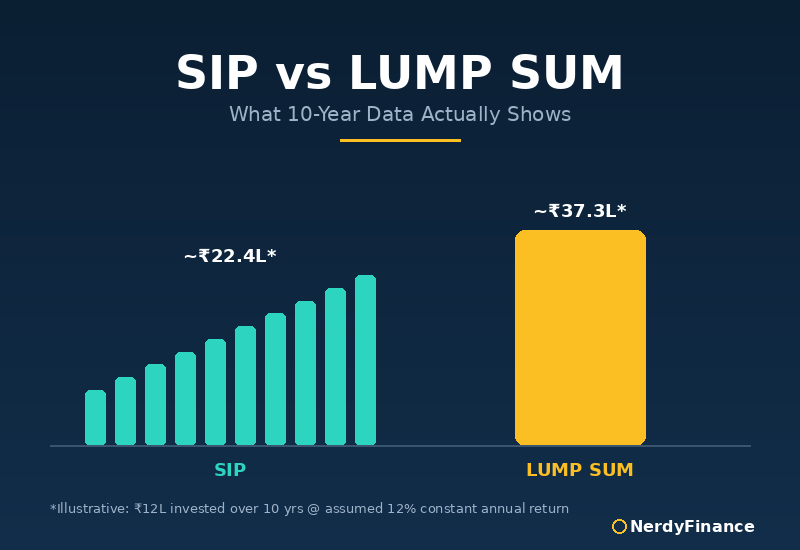
The illustrative math: ₹12 lakh, 10 years, 12% assumed return
Let’s use the exact scenario most comparisons use, so you can see the mechanics clearly. Assume a constant 12% annual return for both (markets never actually move this smoothly, but it isolates why the gap exists):

Same amount invested. Same assumed return. A gap of roughly ₹14.9 lakh.
Why the gap is this large: In the lump sum case, the entire ₹12 lakh has 10 full years to compound. In the SIP case, only your very first ₹10,000 installment gets 10 years of compounding — your last installment only gets one month. On average, your money is invested for roughly half the period compared to the lump sum. Less time in the market, under a constant-return assumption, simply means less compounding.
This is the core mechanical truth behind “lump sum wins” — and it’s real. But it comes with an important asterisk.
The asterisk: markets don’t move in a straight line
The 12% example above assumes returns are smooth and constant every single year. Real markets don’t behave like that — they crash, recover, stagnate, and surge, often within the same decade. And that volatility is exactly what changes the conclusion.
When you look at actual rolling 10-year historical windows on Indian broad market indices rather than a smoothed assumption, two patterns show up consistently across independent market studies:
- Lump sum still wins more often than not over 10-year periods — but the typical margin is far narrower than the ₹14.9 lakh gap above, often in the range of a 1–2 percentage point difference in annualized (CAGR) terms, not a near-doubling.
- The outcome flips depending on entry timing. An investor who put a lump sum in right before a sharp correction (for instance, near the 2000 dot-com peak) saw their SIP counterpart — who kept buying through the crash at lower prices — close the gap substantially, and in some such windows, overtake the lump sum entirely.
In other words: the smoothed math tells you why lump sum has an edge. Real historical data tells you how much that edge actually holds up once you account for the market’s bad days — and the answer is “less than you’d think, and not always.”
When lump sum tends to win
- Markets are in a sustained uptrend. The earlier your full capital is deployed in a rising market, the more of the rise it captures.
- You have a long horizon (10+ years) and don’t need the money soon. Time smooths out the risk of unlucky timing.
- The money wasn’t “future income” anyway — e.g., an inheritance, the sale of a property, or a retirement payout. There’s no monthly discipline to maintain; it’s a one-time decision.
When SIP tends to win (or simply makes more sense)
- You’re investing from salary, not a windfall. You don’t have ₹12 lakh sitting idle — you have ₹10,000 a month. SIP isn’t a “strategy choice” here; it’s the only option that matches how the money actually arrives.
- Markets are volatile or range-bound. Rupee cost averaging means you’re not betting your entire capital on one entry point.
- You’re investing for a long-term goal with low discipline otherwise. The automatic, no-decision nature of SIP is often worth more than a theoretical return advantage — it’s the plan you’ll actually follow.
- You want to reduce regret risk. No one wants to put ₹12 lakh in on the one day before a 20% correction. SIP removes that specific fear, even if it can’t remove market risk altogether.
The real decision framework
Stop asking “which one has better historical returns” and start asking this instead:
“Where is this money coming from, and when do I need it?”
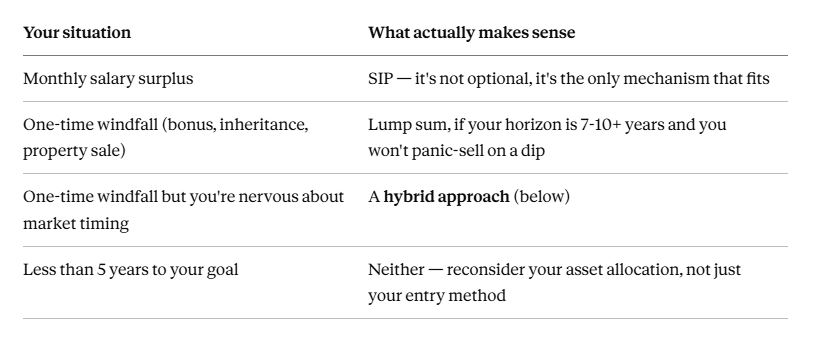
The middle path: STP (Systematic Transfer Plan)
If you have a lump sum but the idea of deploying it all on one uncertain day makes you uneasy, there’s a practical middle ground: park the full amount in a liquid or short-duration debt fund, then set up an STP to automatically move a fixed amount into your equity fund every month over, say, 6–12 months.
You get:
- Your money starts earning (modest) returns from day one instead of sitting idle in a savings account
- The discipline and risk-smoothing of SIP-style entry
- A faster deployment timeline than a pure monthly SIP from scratch
This is the approach worth considering if you’re sitting on a bonus or payout right now and genuinely torn between the two options above.
Frequently asked questions
Does SIP guarantee better returns than lump sum? No. Over most historical 10-year periods, lump sum has had a statistical edge precisely because markets have trended upward over the long run in India. SIP’s advantage isn’t higher average returns — it’s lower entry-timing risk and built-in discipline.
Is 10 years enough to judge SIP vs lump sum? It’s a reasonable horizon for equity mutual funds, but outcomes still vary significantly depending on which specific 10-year window you look at — a decade starting at a market peak looks very different from one starting at a market bottom. This is exactly why rolling-period analysis (not a single example) matters more than one illustrative number.
Can I switch from SIP to lump sum or vice versa partway through? Yes — there’s no rule locking you into one method. Many investors run SIPs for their regular salary savings and invest windfalls separately via lump sum or STP, based on when each type of money becomes available.
What about SIP vs lump sum for debt funds, not equity? The compounding logic is the same, but the volatility that makes rupee cost averaging valuable is much lower in debt funds. For debt allocations, the “when the money arrives” question usually matters more than the entry-timing debate.
The bottom line
The ₹12 lakh, ₹14.9-lakh-gap example is useful for understanding why lump sum has a mechanical compounding edge — but it’s not a prediction of what will happen to your money. Real markets are lumpy, and that lumpiness is precisely what narrows — and sometimes reverses — the gap.
If you’re investing from your salary, this debate is mostly academic: SIP is simply how that money gets invested. If you’re sitting on a windfall and deciding between a lump sum, an STP, or waiting — that’s the decision actually worth thinking through, and it depends far more on your time horizon and your ability to stay invested through a bad year than on which strategy “wins” in a spreadsheet.