Gold Price Prediction 2026: Where Is Gold Headed by Year-End?
If you’ve checked your local jeweller’s board this month, you already know something unusual is happening. Gold isn’t just rising — it’s rewriting records. As of early August 2026, 24-karat gold in India is trading around ₹1.44–1.50 lakh per 10 grams, and internationally, gold has already smashed through $4,000/oz, even touching $5,300/oz briefly in February 2026.
So the question every salaried Indian is asking right now: is it too late to buy gold, or is the real rally still ahead of us?
This post breaks down where major banks and analysts think gold is headed by the end of 2026, why prices have moved so sharply this year, and how you — a salaried professional trying to build real wealth — should actually think about gold in your portfolio.
Gold Price Today: Where We Stand (August 2026)
- India (24K): ~₹1,44,000–₹1,50,000 per 10 grams
- India (22K): ~₹1,32,000–₹1,38,000 per 10 grams
- International spot: ~$4,000–$4,300/oz, down from a February 2026 peak above $5,300/oz
Gold’s 2026 story so far has been dramatic: a sharp rally in January driven by escalating Middle East tensions and renewed US–Iran friction, a record spike in February, a cooling-off through spring, and a mostly sideways summer as markets digest what comes next.
Domestically, two extra forces are at play that pure international forecasts often miss:
- A weaker rupee — every rupee of depreciation against the dollar pushes Indian gold prices higher, independent of global rates.
- Higher import duty — India raised gold import duty from 6% to 15% in May 2026, adding further upward pressure on retail prices even when international rates are flat.
Gold Price Prediction for End of 2026: What the Experts Say
Here’s where it gets interesting — and where you should be skeptical of any single number. Forecasts for gold by December 2026 span an unusually wide range, because analysts fundamentally disagree on the US Federal Reserve’s rate path and how geopolitical conflict resolves.
The bullish camp
- J.P. Morgan Global Research is the most aggressive, projecting gold could push toward $6,000/oz by year-end 2026.
- Goldman Sachs expects a 20% rise from earlier-2026 levels.
- The World Gold Council (WGC) projects gold could climb as much as 30%, citing continued central bank buying and safe-haven demand.
- Translated to Indian prices, several of these bullish scenarios put 24K gold in the ₹1.8 lakh–₹2 lakh per 10 grams range by December, especially if the rupee stays weak and Q4 wedding/Dhanteras season demand holds up.
The cautious/bearish camp
- Some technical forecasting models (LongForecast, CoinCodex) actually predict a pullback, with gold closing 2026 anywhere from $3,288 to $3,578/oz — well below current levels — as rising global gold production and a potentially stronger dollar cap the rally.
- The consensus “base case” among more measured analysts is stabilization followed by gradual recovery, not a straight-line moonshot in either direction.
Why the disagreement?
Three swing factors explain almost the entire gap between these forecasts:
- US Fed policy — rate cuts weaken the dollar and typically boost gold; a hawkish pivot does the opposite.
- Geopolitical conflict resolution — continued Middle East tensions support safe-haven buying; any de-escalation removes a key prop under prices.
- Central bank gold demand — reserve-building by central banks (especially in emerging markets) has been a major structural tailwind through 2025–26; any slowdown here changes the math significantly.
Bottom line: Nobody has a crystal ball, and even Goldman Sachs and JP Morgan won’t agree with each other. Treat any single-number “target price” you see in a headline as one scenario among several, not a guarantee.
Why Gold Has Rallied So Hard in 2026
For context, it helps to understand why gold has moved this much in a single year:
- Geopolitical risk — escalating conflict has pushed institutional money out of equities and into gold, which carries no counterparty risk.
- Persistent inflation concerns globally have kept gold’s appeal as an inflation hedge intact.
- Central bank buying — many central banks, particularly in Asia, have been steadily adding to gold reserves rather than holding US dollar assets.
- Currency effects in India — rupee depreciation has amplified international gold price moves for Indian buyers specifically.
None of these forces resolve quickly, which is exactly why forecasts stay so uncertain — and why gold has stayed relevant in portfolio conversations all year.
What This Means for You as a Salaried Indian Investor
Here’s the part most “gold price prediction” articles skip: the forecast number matters less than how gold fits your actual financial plan.
1. Gold is a hedge, not a growth engine
Gold’s job in your portfolio is to protect purchasing power and reduce volatility when equities fall — not to be your primary wealth-building asset. If gold is currently more than 15–20% of your total investments, you’re likely over-allocated for a salaried investor in the 21–40 age bracket with a long investment horizon.
2. Don’t chase the rally
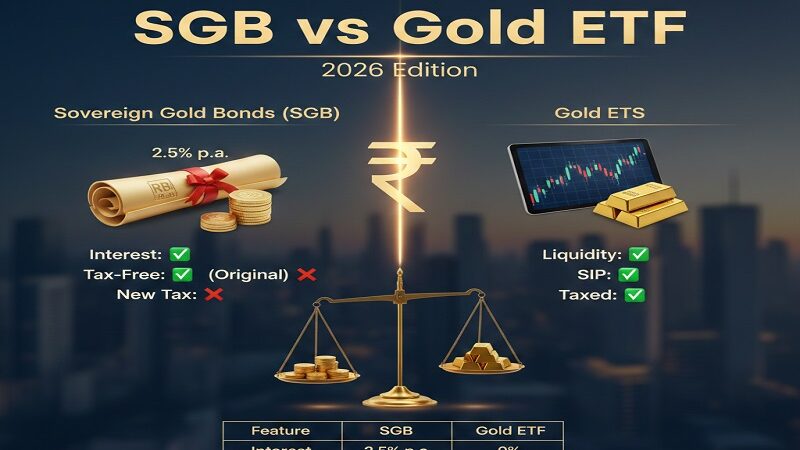
Buying gold because it’s up 20-30% this year is the same mistake as buying a stock because it’s trending. If you don’t already hold gold, consider staggering purchases (SIP-style, via Sovereign Gold Bonds or Gold ETFs) rather than putting a lump sum in at current highs.
3. Prefer paper gold over physical gold
Sovereign Gold Bonds (SGBs, when available) and Gold ETFs avoid making charges, purity concerns, and storage risk — all real costs that eat into physical gold’s returns, especially relevant now that import duty has pushed retail prices even higher.
4. Match the instrument to the goal
- Short-term liquidity/safety: Gold ETFs
- Long-term wealth preservation: SGBs (interest + potential tax-free capital gains on maturity)
- Cultural/wedding purchases: Physical gold — but treat this as consumption, not investment
Gold Price Prediction 2026: Quick FAQ
Will gold reach ₹2 lakh per 10 grams by the end of 2026? It’s possible under the bullish scenarios from Goldman Sachs and the World Gold Council, but not guaranteed. It would require continued rupee weakness, sustained geopolitical tension, and strong Q4 festive/wedding demand all playing out together.
Is it a good time to buy gold right now? There’s no universal answer — it depends on your existing allocation, goals, and time horizon. Buying in small tranches rather than a lump sum reduces the risk of buying at a short-term peak.
Should I sell my gold if prices are at record highs? If gold has grown to an outsized share of your portfolio, partial profit-booking to rebalance can make sense — but this is a portfolio decision, not a market-timing bet.
What affects gold prices in India specifically, beyond global rates? Primarily the rupee-dollar exchange rate, import duty (raised to 15% in May 2026), GST, and seasonal demand around Dhanteras and wedding season.
The Real Takeaway
Every institution from JP Morgan to CoinCodex has a different number for where gold lands by December 2026 — anywhere from a further pullback to $6,000/oz. That spread alone tells you the honest answer: nobody knows for certain, and you shouldn’t build your financial plan around any single prediction.
What you can control is your allocation, your entry strategy, and choosing the right instrument for your goal. That’s a far more reliable path to financial security than trying to time gold’s next move.
Disclaimer: This is educational content, not investment advice. Gold forecasts vary widely between institutions and should never be the sole basis for a financial decision. Please consult a SEBI-registered advisor before making investment decisions.