India’s Household Debt Just Hit 41.3% of GDP — And It’s Not the Kind of Debt That Builds Wealth
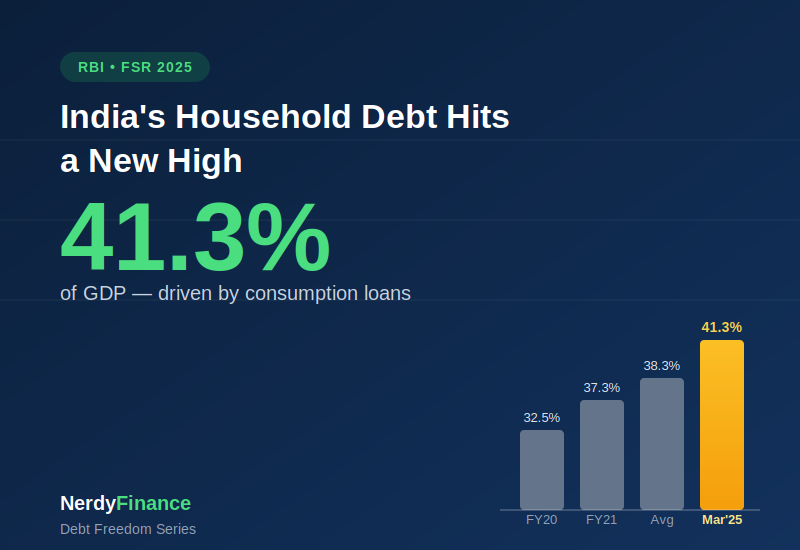
Here’s a number that should make every salaried Indian pause: household debt in India rose to 41.3% of GDP by the end of March 2025, according to the Reserve Bank of India’s Financial Stability Report. That’s above the five-year average of 38.3%, and it’s still climbing.
But the scarier part isn’t the headline number. It’s what kind of debt is driving it.
This isn’t home loan debt building an asset. It’s not business debt funding growth. It’s consumption-oriented retail debt — personal loans, credit cards, and auto loans — that people are taking on just to manage everyday expenses. And once you understand the shape of this trend, it becomes a lot easier to make sure you’re not part of the statistic.
What the RBI Data Actually Says
Let’s break down the numbers, because the details matter more than the headline:
- 41.3% of GDP: India’s household debt-to-GDP ratio at the end of March 2025, up from a five-year average of 38.3%.
- 55.3%: The share of total household borrowing from financial institutions made up of non-housing retail loans (personal loans, credit cards, auto loans) as of September 2025 — the single largest category, and growing.
- 29%: The share of household debt that’s actually home loans — an asset-building form of debt. In other words, consumption debt now dwarfs the debt that builds long-term wealth.
- ₹4.8 lakh: The average outstanding debt per individual borrower as of March 2025, up sharply from around ₹3.9 lakh just two years earlier — a jump of nearly 11% year-on-year.
- 5.1% of GDP: India’s net household financial savings rate, a level near a multi-decade low.
Put these together and the pattern is unmistakable: Indians are saving less and borrowing more, and the borrowing is increasingly going toward consumption, not asset creation.
The RBI itself was direct about this — noting that even though India’s household debt remains lower than most peer emerging markets, the composition of that debt (heavily consumption-led rather than tied to housing or productive assets) is the real concern.
Why This Is Happening: The Squeeze Most People Don’t Name
If you’re a salaried professional in your late 20s or 30s in a metro city, this data probably doesn’t feel abstract — it might feel familiar. A few forces are converging:
1. Easy access to credit, everywhere. Buy-now-pay-later, instant personal loan apps, pre-approved credit card limits landing in your inbox — credit has never been more frictionless to access. The barrier between “I want this” and “I bought this on EMI” has nearly disappeared.
2. Lifestyle costs rising faster than salaries. Rent, healthcare, education, and everyday consumption costs have climbed steadily, while salary increments for a large chunk of the salaried workforce haven’t kept pace in real terms.
3. EMI culture normalized as “smart” spending. Splitting a ₹40,000 purchase into “just ₹3,333/month” feels harmless. But stack five or six of these EMIs — phone, appliance, vacation, wedding expenses, a personal loan to cover another EMI — and you get exactly the kind of consumption-debt pileup the RBI is flagging.
4. No formal financial education. Most of us were never taught the difference between debt that builds wealth (a home loan, an education loan for a high-ROI degree) and debt that quietly erodes it (a personal loan for a phone, a credit card rolled over month to month).
This is the exact gap NerdyFinance exists to close — the crisis isn’t that we don’t earn enough, it’s that we were never taught what to do with what we earn.
Good Debt vs. Bad Debt: The Distinction the RBI Data Is Really About
Not all debt is destructive. The problem the RBI is highlighting is a shift in composition — away from debt that builds assets, toward debt that funds consumption. Here’s the practical way to think about it:
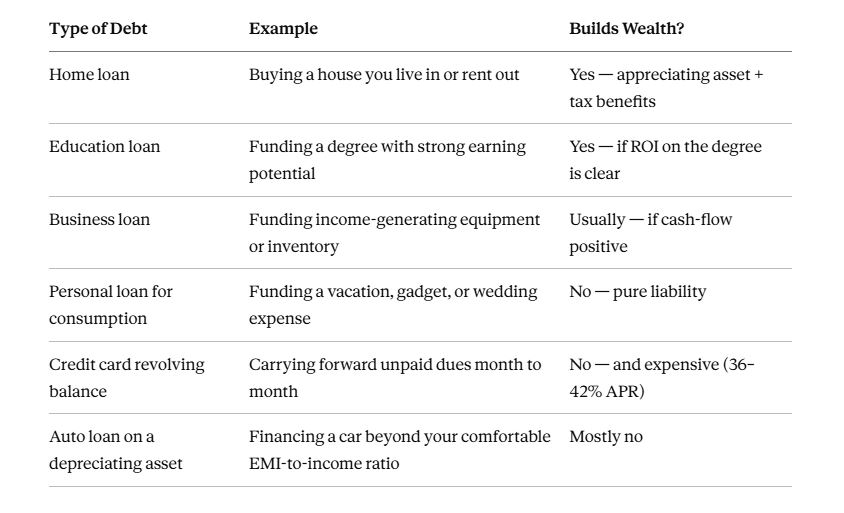
If most of your current EMIs sit in the bottom half of this table, you’re not alone — you’re part of a national trend. But that also means you have real leverage to course-correct, because the fix isn’t complicated. It’s just rarely explained clearly.
How to Know If You’re At Risk
A few honest questions to ask yourself:
- Is your total EMI outgo above 40% of your take-home income? Above this threshold, most financial planners consider you over-leveraged.
- Have you taken a new loan or used a credit card to pay off an existing loan? This is the clearest sign of a debt spiral, not just debt.
- Do you know your total outstanding debt across all loans and cards, off the top of your head? If not, that itself is a red flag — you can’t fix what you don’t measure.
- Has your savings rate dropped in the last two years while your EMI count has gone up? That mirrors exactly what’s happening at the national level.
Three Things You Can Do Starting This Month
1. Do a full debt audit. List every loan and credit card: outstanding amount, interest rate, and EMI. Most people are surprised by how much of their monthly income is already spoken for before they’ve even opened their salary account.
2. Attack the highest-interest debt first. Credit card debt and unsecured personal loans (often 15–42% APR) should always be paid down before you accelerate any low-interest, asset-backed loan like a home loan.
3. Separate “want” spending from “EMI-funded” spending. If you wouldn’t buy something in cash today, that’s usually a sign you shouldn’t be financing it either. Build a buffer fund first — even a small one — so the next unexpected expense doesn’t become another EMI.
The Bottom Line
A 41.3% household debt-to-GDP ratio isn’t a crisis by itself — many economies run higher. What makes this RBI data worth paying attention to is the trend and the composition: rising consumption debt, falling savings, and a growing share of borrowers who are using new loans to service old ones.
The good news is that this is a personal-finance problem with a personal-finance solution. You don’t need to fix India’s household debt ratio. You just need to make sure your own EMIs are funding your future, not quietly draining it.