UGC 2026- is general caste not have right of education
Introduction: When Good Intentions Meet Ground Reality
On January 13, 2026, the University Grants Commission (UGC) notified a set of regulations that would fundamentally reshape how Indian universities handle discrimination. The “Promotion of Equity in Higher Education Institutions Regulations, 2026” promised to create safer, more inclusive campuses. Instead, within days, it ignited a firestorm of controversy that has led to nationwide protests, political resignations, Supreme Court petitions, and a hashtag—#ShameOnUGC—trending across social media.
This isn’t just another bureaucratic policy debate. At its heart lies a question that goes to the core of Indian society: How do we address historical injustices without creating new ones? Can regulations designed to protect the vulnerable inadvertently marginalize others? And in our quest for equity, have we lost sight of equality?
To understand this controversy, we need to trace its origins, examine what the regulations actually say, understand why they’ve sparked such fierce opposition, and consider what this means for the future of Indian higher education.
The Tragic Genesis: Rohith Vemula and Payal Tadvi
The story of these regulations begins not in policy rooms but in tragedy—two young lives lost to what their families and supporters call “institutional murder.”
Understanding the Crisis: The Numbers Behind the Regulations
Before diving into what the regulations say, it’s crucial to understand why UGC felt compelled to act. According to data cited by UGC, there was a staggering 118.4% increase in reported cases of caste-based discrimination between 2019 and 2024. Complaints rose from approximately 173 cases in 2019-20 to 378 cases in 2023-24, totaling over 1,160 reported incidents during this period.
But these numbers tell only part of the story. Many experts believe this represents just the tip of the iceberg, as numerous cases go unreported due to:
- Fear of retaliation
- Lack of trust in institutional mechanisms
- Social stigma and isolation
- Absence of effective support systems
- Students’ vulnerability in power hierarchies
Between 2016 and 2021 alone, 98 students from Dalit, Bahujan, and Adivasi communities died by suicide in central universities and elite institutions like IITs, NITs, IIMs, and IISERs. In 2023, Darshan Solanki, an 18-year-old Dalit student at IIT Bombay, died by suicide within months of joining. While internal inquiries attributed his death to “academic stress,” subsequent student surveys revealed deep-seated fear of caste disclosure, discomfort with caste-indicative questioning, and profound mistrust in grievance mechanisms.
These aren’t just statistics—they represent young lives, unfulfilled potential, and families shattered by loss. They paint a picture of campuses where discrimination operates not just through overt acts but through subtle exclusion, microaggressions, differential treatment, and systemic bias that creates an unbearable psychological burden.
What the Regulations Actually Say
The UGC (Promotion of Equity in Higher Education Institutions) Regulations, 2026 replace the earlier 2012 guidelines with a legally binding framework. Here are the key provisions:
1. Institutional Infrastructure
Equal Opportunity Centres (EOCs): Every higher education institution must establish an Equal Opportunity Centre. These centers are tasked with:
- Promoting inclusion and supporting disadvantaged students
- Receiving and handling discrimination complaints
- Coordinating with civil society groups, police, district administration, and legal aid services
- Conducting awareness programs
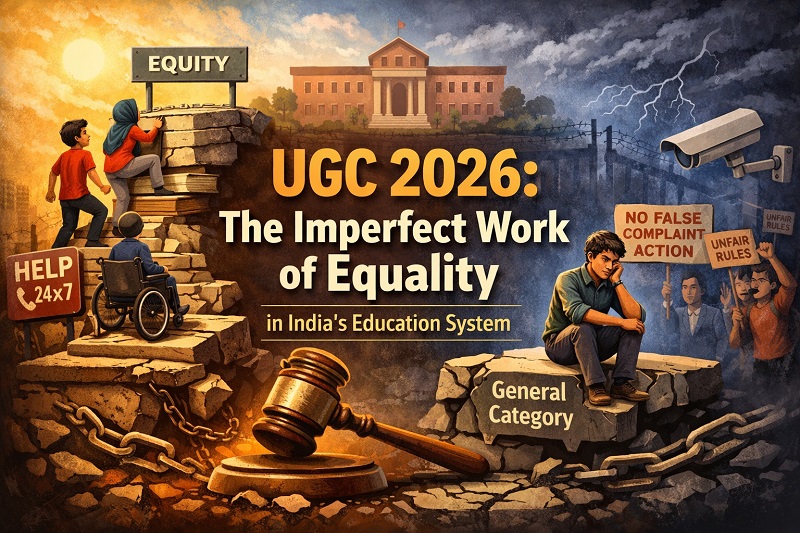
Equity Committees: Each institution must form an Equity Committee, chaired by the head of the institution (Vice-Chancellor or Principal), with mandatory representation from:
- Scheduled Castes (SC)
- Scheduled Tribes (ST)
- Other Backward Classes (OBC)
- Persons with Disabilities (PwBD)
- Women
These committees must meet at least twice a year and submit bi-annual reports to UGC.
24/7 Helplines: Institutions must establish round-the-clock helplines for reporting discrimination.
Equity Squads/Ambassadors: These are monitoring teams designated to observe vulnerable campus areas and promote equity awareness.
2. Grievance Redressal Mechanism
The regulations establish a structured process:
- Complaints can be filed with the Equal Opportunity Centre
- The Equity Committee investigates complaints within defined timelines
- If a case under penal laws is established, institutions must register FIRs promptly
- Complainants unsatisfied with the committee’s decision can appeal to an independent Ombudsperson within one month
- The Ombudsperson’s decisions are binding on the institution
3. Definitions and Scope
This is where the controversy truly begins. According to Regulation 3(c), “caste-based discrimination” is defined as: “discrimination only on the basis of caste or tribe against the members of the scheduled castes, scheduled tribes, and other backward classes.”
The regulations cover discrimination based on various grounds including caste, religion, gender, disability, race, and place of birth. However, the explicit definition of “caste-based discrimination” as applying only to SC/ST/OBC members has become the lightning rod for criticism.
4. Enforcement and Accountability
Unlike the 2012 guidelines, these regulations have teeth. Institutions that fail to comply face serious consequences:
- Denial of UGC schemes and funding
- Restrictions on offering degree, distance, or online programs
- Withdrawal of UGC recognition
- Debarment from various benefits
Institutional heads are held directly accountable, with annual compliance reports required.
The Firestorm: Why General Category Students Are Protesting
Within days of the regulations being notified, protests erupted across university campuses in Uttar Pradesh, Rajasthan, Bihar, and other states. The hashtag #ShameOnUGC began trending. Students called for protests outside UGC headquarters in Delhi. Political workers resigned from party posts. Even a suspended bureaucrat, Bareilly City Magistrate Alankar Agnihotri, joined protests, alleging harassment and questioning, “Who is abusing me for being a Pandit?”
What sparked this fury? General category students and their supporters have raised several specific concerns:
1. One-Sided Definition of Discrimination
The most explosive issue is the definition in Regulation 3(c). Critics argue that by defining “caste-based discrimination” as applying only against SC/ST/OBC members, the regulations implicitly exclude general category students from protection. This creates what protesters call a “predetermined victim” framework where only certain communities can be recognized as victims of caste discrimination.
As one student activist argued: “The burden of proof is completely shifted onto the accused, with no safeguards for wrongly accused students. The definition of victim is already predetermined—you can only be a victim if you’re from SC/ST/OBC. What if a general category student faces harassment based on their caste? Are they simply invisible to this system?”
2. Committee Composition Imbalance
The Equity Committees must include representatives from SC, ST, OBC, PwBD, and women—but there’s no mandate for representation from general category students. Critics fear this creates institutional bias, arguing that committees investigating sensitive caste issues should include diverse perspectives to ensure impartial judgment.
As an opinion piece in India Today NE argued: “Despite the positive intent behind the 2026 UGC equity regulations, they carry serious flaws that tilt the scales unfairly. Most glaringly, Equity Committees must include members from SC, ST, OBC, PwBD, and women categories, but there’s no mandate for General Category representation, raising real fears that these bodies could lean one-sided.”
3. No Safeguards Against False Complaints
One of the most vociferous complaints is the absence of provisions to penalize false or malicious complaints. In an environment where accusations of caste discrimination can severely damage someone’s reputation and career, protesters argue there must be accountability for those who make baseless allegations.
This concern isn’t merely hypothetical. In India’s polarized social climate, where caste politics runs deep, there are genuine fears that the Equity Squad system could be weaponized to settle personal grudges or target individuals based on their caste identity.
4. Vague Definitions and Broad Powers
Critics point to vague definitions of what constitutes discrimination. The regulations define discrimination broadly to include not just explicit acts but also “implicit bias and systemic exclusion.” While this comprehensive approach aims to catch subtle forms of discrimination, opponents worry it creates too much room for subjective interpretation.
Combined with the broad monitoring powers of Equity Squads, this has led to fears of a campus environment where students constantly fear being accused based on unclear standards.
5. Perceived “Reverse Discrimination”
Some general category students and organizations have used stronger language, calling the regulations a “black law” and alleging they create “reverse discrimination.” Protest banners have read: “The new UGC ‘Equity’ Regulations 2026 shamelessly brand General Category students as perpetrators of violence on campuses—simply for being born into non-reserved families!”
Poet Kumar Vishwas captured this sentiment by posting: “Chahe til lo ya taad lo raja, raai lo ya pahad lo raja, main abhaga ‘savarn’ hoon mera, rounya rounya ukhad lo raja” (Whether you take a sesame or a mountain, O King, take a mustard seed or a mountain, O King, I am the unfortunate ‘upper caste’, uproot my tears, O King).
The Deeper Questions We Must Confront
Beyond the technical details of regulations lies a deeper question: How does India create truly equitable educational institutions?
The Nature of Discrimination
Caste discrimination operates differently from discrimination based on other identities. It’s embedded in social structure, internalized across generations, manifested through subtle cues and unspoken assumptions. A regulation can mandate committee formation, but can it change mindsets?
The Limits of Law
Anti-ragging regulations significantly reduced ragging incidents because ragging is a discrete, visible act. But caste discrimination is often ambient, diffuse, cumulative—microaggressions that individually seem minor but collectively create unbearable psychological burden. Can legal frameworks address this effectively?
Competing Justice Claims
When different groups see themselves as victims of injustice, how do we create systems that acknowledge multiple experiences without hierarchy? Is it possible to protect historically disadvantaged groups while also ensuring nobody else faces discrimination?
Merit vs. Equity
Indian education has long claimed to be meritocratic, yet merit itself is shaped by privilege. A student who attended elite schools, had tutors, grew up in a home full of books, and never worried about where the next meal comes from has advantages that shape their “merit.” How do we think about fairness in this context?
The Role of Institutions
Ultimately, regulations are only as good as the institutions implementing them. If university administrators, faculty, and students don’t genuinely commit to creating inclusive environments—if they view regulations as burdensome compliance requirements rather than opportunities for genuine transformation—no amount of legal text will matter.
Conclusion: The Work of Justice Is Never Simple
The UGC Equity Regulations 2026 controversy reveals a fundamental truth: the work of justice is never simple, clean, or uncontested. Every attempt to address historical wrongs risks creating new grievances. Every protection for one group raises questions about protections for others. Every definition includes some and excludes others.
Radhika Vemula and Abeda Tadvi didn’t seek these regulations to divide campuses or create new conflicts. They sought them because their children are dead—victims of a discrimination so pervasive and so normalized that institutions failed to see it until it was too late.
The question isn’t whether Rohith and Payal faced discrimination. The evidence is overwhelming that they did. The question is whether these regulations—imperfect, contested, evolving—can prevent future Rohiths and Payals without creating new victims.
Perhaps the answer lies not in perfect regulations but in collective commitment. In faculty who mentor students across caste lines. In students who refuse to participate in exclusion. In administrators who take complaints seriously from the start. In communities that acknowledge historical wrongs while extending compassion to all who suffer. In mechanisms that are both protective and fair. In institutions that see diversity as strength rather than problem.
The controversy over these regulations isn’t ending soon. But maybe that’s okay. Maybe working through these tensions, painful as it is, is itself part of the process of becoming a more just society. Maybe the conversation these regulations have sparked—about discrimination, fairness, protection, due process, history, and hope—is exactly the conversation India needs to have.
What’s certain is this: We cannot afford more Rohiths and Payals. But we also cannot afford to create a campus environment where new injustices emerge in the name of addressing old ones. The challenge is finding that path—and it will require wisdom, empathy, good faith, and the willingness to keep revising our approaches as we learn.
The work of justice is never finished. It’s always imperfect. It’s always contested. And it’s always necessary.