SIP vs Lump Sum Investment: Create wealth without losing
When it comes to investing in mutual funds, one of the most common dilemmas investors face is choosing between SIP (Systematic Investment Plan) and lump sum investment. Both strategies have their merits, and understanding the nuances can help you make an informed decision that aligns with your financial goals.
Understanding the Basics
What is SIP?
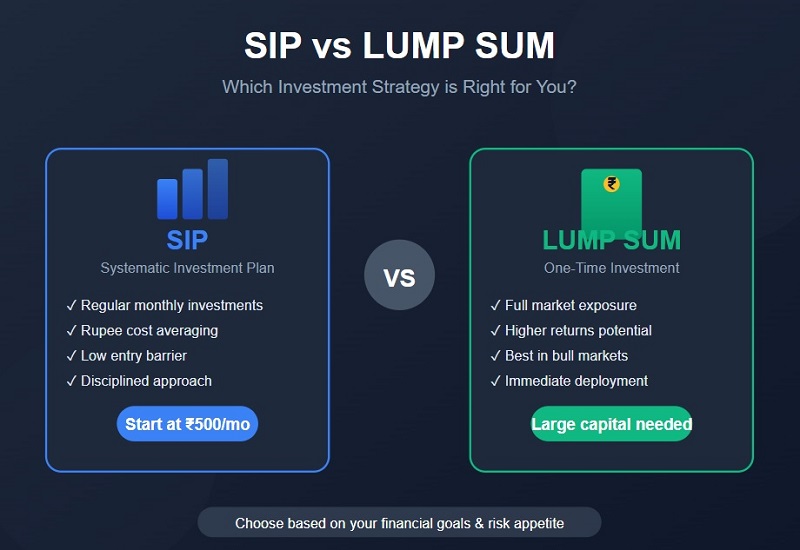
A Systematic Investment Plan (SIP) is a disciplined approach to investing where you invest a fixed amount regularly—monthly, quarterly, or at any interval you choose. Think of it like paying an EMI, except you’re building wealth instead of paying off debt.
Example: Priya, a 28-year-old software engineer, invests ₹10,000 every month in a diversified equity mutual fund through SIP. Over time, she buys more units when prices are low and fewer units when prices are high.
What is Lump Sum Investment?
Lump sum investment involves investing a large amount of money all at once. This could be from a bonus, inheritance, business sale, or accumulated savings.
Example: Rajesh received ₹5 lakh as an annual bonus and decided to invest the entire amount in a mutual fund in one go.
SIP Investment: Advantages and Disadvantages
Advantages of SIP
1. Rupee Cost Averaging
This is the biggest advantage of SIP. When markets fall, your fixed investment amount buys more units. When markets rise, you buy fewer units. Over time, this averages out your purchase cost.
Real scenario: During the COVID-19 market crash in March 2020, investors who continued their SIPs bought units at significantly lower NAVs. When markets recovered, their returns were substantially higher than those who stopped investing.
2. Power of Compounding
Starting early with small amounts can create substantial wealth. Even ₹5,000 per month invested for 20 years at 12% annual returns can grow to approximately ₹50 lakhs.
3. Disciplined Investing
SIPs create a habit of regular saving and investing. The automation removes the emotional aspect of investing and the temptation to time the market.
4. No Market Timing Required
You don’t need to worry about whether the market is at a peak or trough. Your investments continue regardless of market conditions.
5. Affordable Entry Point
You can start a SIP with as little as ₹500 per month, making it accessible to everyone from students to seasoned professionals.
6. Flexibility
You can increase, decrease, pause, or stop your SIP based on your financial situation without any penalties in most cases.
Disadvantages of SIP
1. Lower Returns in Bull Markets
When markets are consistently rising, SIPs may generate lower returns compared to lump sum investments because you’re deploying capital gradually rather than benefiting from the entire rally.
2. Longer Wealth Accumulation
Building a substantial corpus takes time with SIPs. If you need quick wealth creation, this might not be ideal.
3. Transaction Costs
Some platforms or fund houses may charge transaction fees for each SIP installment, though most direct plans have eliminated this.
4. Commitment Required
To see real benefits, you need to stay invested for at least 5-7 years, which requires patience and discipline.
Lump Sum Investment: Advantages and Disadvantages
Advantages of Lump Sum
1. Maximum Market Exposure
Your entire capital works for you from day one. In a rising market, this can generate significantly higher returns.
Real example: An investor who put ₹10 lakhs as lump sum in January 2020 in a Nifty 50 index fund saw their investment grow by over 90% by December 2024, despite the COVID crash in between.
2. Suitable for Windfall Gains
When you receive a large sum suddenly—inheritance, property sale, bonus, or maturity proceeds—lump sum investing helps deploy the capital immediately.
3. Lower Transaction Complexity
One-time investment means less paperwork, fewer transactions to track, and simpler portfolio management.
4. Better for Debt Funds
In stable or falling interest rate scenarios, lump sum works better for debt funds where timing matters more than equities.
Disadvantages of Lump Sum
1. Market Timing Risk
Investing your entire capital at market peaks can significantly impact returns. If the market corrects immediately after investment, it may take years to recover.
Real scenario: Investors who invested lump sum amounts in January 2008 (before the global financial crisis) had to wait nearly 3 years just to break even.
2. Emotional Stress
Watching your large investment lose value during market downturns can be psychologically challenging and may lead to panic selling.
3. Requires Significant Capital
Not everyone has a large amount readily available for investment, making this approach less accessible.
4. Higher Risk Concentration
Investing everything at once means all your capital faces the same market conditions, without the benefit of averaging.
Historical Performance: The Numbers Don’t Lie
Let’s look at actual data from Indian markets:
Scenario 1: Bull Market (2014-2017)
- Lump sum investment in January 2014: ₹10 lakhs grew to approximately ₹17.5 lakhs
- SIP of ₹27,778 per month for 36 months: Same ₹10 lakh investment grew to approximately ₹15.2 lakhs
- Winner: Lump Sum (higher returns)
Scenario 2: Volatile Market (2016-2020)
- Lump sum investment in January 2016: ₹10 lakhs grew to approximately ₹13.8 lakhs
- SIP of ₹20,833 per month for 48 months: Same ₹10 lakh investment grew to approximately ₹14.5 lakhs
- Winner: SIP (better risk-adjusted returns)
Which Strategy Should You Choose?
Choose SIP if:
- You’re a salaried individual with regular monthly income
- You’re new to investing and want to build discipline
- You have a long investment horizon (5+ years)
- You want to reduce market timing risk
- You don’t have a large sum available immediately
- You prefer sleeping peacefully regardless of market volatility
Choose Lump Sum if:
- You have a windfall amount to invest
- You have high risk tolerance
- Markets are trading at reasonable valuations
- You have done thorough research or are working with a financial advisor
- Your investment horizon is long enough to weather potential downturns
- You understand and accept the volatility
The Hybrid Approach: Best of Both Worlds
Many experienced investors use a combination strategy called Systematic Transfer Plan (STP):
- Park your lump sum in a liquid or ultra-short-term debt fund
- Set up an STP to transfer a fixed amount regularly into equity funds
- This gives you debt fund returns on unutilized capital while averaging your equity entry
Example: Meera received ₹15 lakhs. She invested the entire amount in a liquid fund and set up an STP of ₹1 lakh per month into an equity fund. This way, she earned 6-7% on her debt allocation while gradually entering equities.
Tax Implications You Should Know
For Equity Funds:
- Long-term capital gains (held over 1 year): 12.5% tax on gains above ₹1.25 lakh
- Short-term capital gains: 20% tax
For Debt Funds:
- Gains taxed as per your income tax slab, regardless of holding period
SIP Advantage: Each SIP installment is treated as a separate investment for tax purposes, giving you flexibility in tax planning.
Common Mistakes to Avoid
With SIP:
- Stopping during market downturns (this is when SIPs work best!)
- Starting with too high an amount that becomes difficult to sustain
- Not increasing SIP amount as income grows
With Lump Sum:
- Investing entire capital without keeping emergency funds
- Panic selling during market corrections
- Not diversifying across asset classes
Real-Life Success Story
Anil started a SIP of ₹15,000 in 2010 in a diversified equity fund. Over 15 years, despite market crashes, COVID-19, and various crises, he stayed invested. His total investment of ₹27 lakhs has grown to approximately ₹89 lakhs as of 2025—that’s over 3X returns!
Meanwhile, his colleague Suresh invested ₹27 lakhs as lump sum in 2010 in the same fund. His investment is now worth approximately ₹1.1 crores. Higher returns, but he had the capital, conviction, and importantly, he stayed invested through all the volatility.
Final Verdict
There’s no universal answer to the SIP vs lump sum debate. The right choice depends on your financial situation, risk appetite, investment goals, and market conditions.
For most individuals, especially those building wealth gradually, SIP remains the more practical and emotionally manageable option. It removes the pressure of market timing and builds financial discipline.
However, if you have a large corpus and the right market conditions (reasonable valuations), lump sum can deliver superior returns—provided you have the stomach to handle volatility.
Pro tip: Don’t let perfect be the enemy of good. The most important thing is to start investing. Whether you choose SIP or lump sum, staying invested for the long term is what truly matters. As the saying goes, “Time in the market beats timing the market.”
Disclaimer: This article is for educational purposes only and should not be considered financial advice. Please consult with a certified financial advisor before making investment decisions. Past performance does not guarantee future results.
Have questions about your investment strategy? Share your thoughts in the comments below!