NPS Made Simple: Tax Savings + Retirement Income
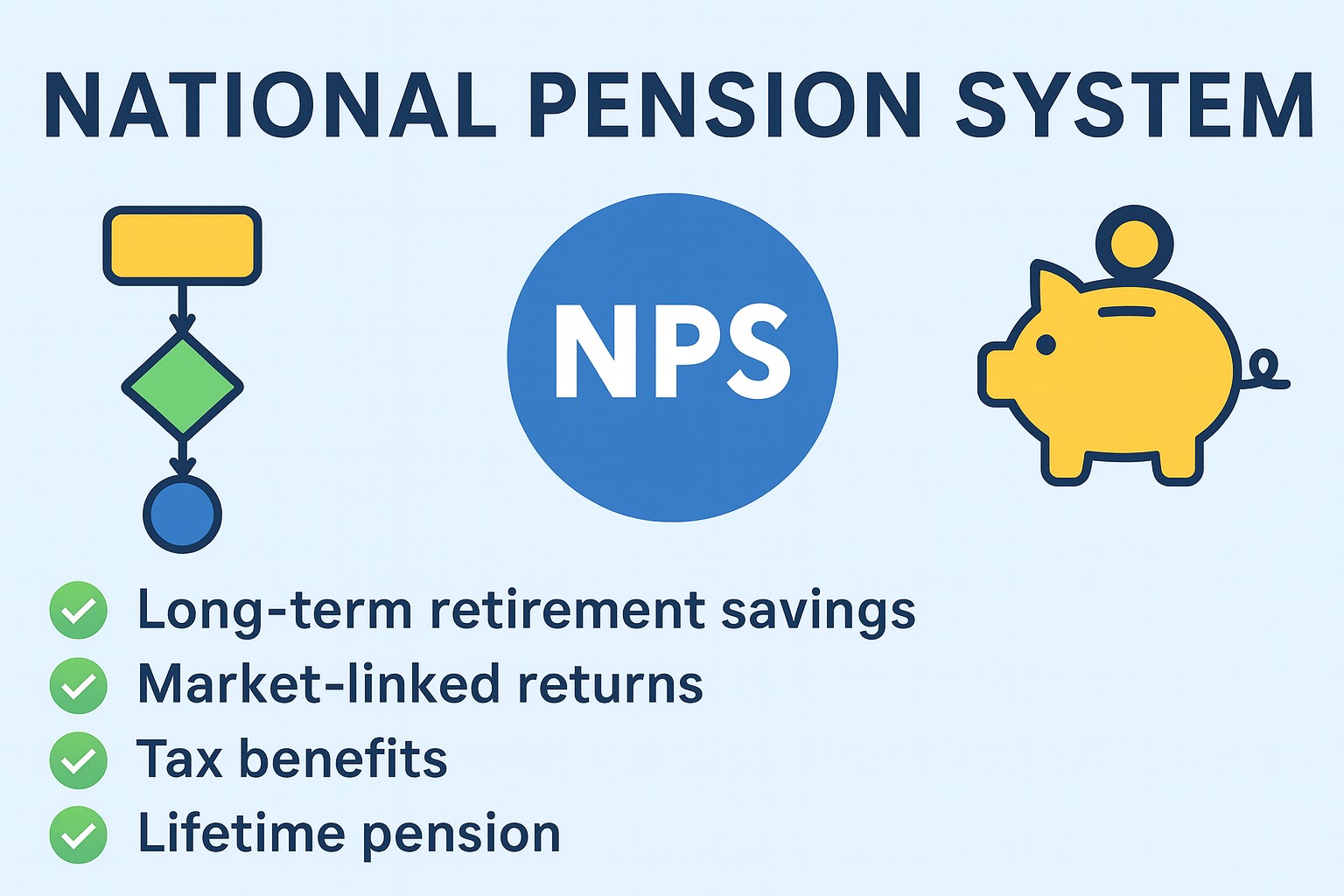
The National Pension System is a voluntary, long-term retirement savings scheme regulated by PFRDA (Pension Fund Regulatory & Development Authority).
It’s designed to help you build a pension corpus during your working life and then receive a steady income after retirement.
⚙️ How NPS Works (Simple Flow)
1️⃣ You Contribute During Your Working Years
- You can invest monthly or yearly — as per your comfort.
- Minimum contribution: ₹500 per month (Tier I).
- Maximum: No limit, but tax benefits apply up to certain limits.
Example: You invest ₹5,000/month in NPS from age 30 to 60.
2️⃣ Your Money is Invested in Market-Linked Assets
NPS invests your money in a mix of:
| Asset Type | Description |
|---|---|
| E | Equity (stocks) — for high growth |
| C | Corporate debt — for moderate returns |
| G | Government bonds — for safety |
| A | Alternative assets — optional (like REITs) |
You can choose between:
- Active Choice: Decide your own mix (E, C, G, A).
- Auto Choice: System automatically adjusts your asset mix based on your age (more equity when young, more debt near retirement).
3️⃣ Compounding Grows Your Corpus
Your investments earn returns (usually 8–10% p.a. on average, market-linked).
Over decades, compounding creates a large retirement fund.
💡 Example:
₹5,000/month @ 9% for 30 years = ₹88 lakh+ corpus.
Use the NPS Calculator to check your pension corpus
4️⃣ Withdrawals at Retirement (Age 60)
At age 60:
- You can withdraw up to 60% of your corpus tax-free as a lump sum.
- The remaining 40% must be used to buy an annuity — which gives you monthly pension income.
💡 Example:
If your corpus = ₹1 crore
→ ₹60 lakh you get tax-free
→ ₹40 lakh used to buy an annuity (which might pay ~₹25,000/month for life).
5️⃣ Tax Benefits (Major Advantage)
| Section | Benefit | Limit |
|---|---|---|
| 80CCD(1) | Deduction for self-contribution | Up to ₹1.5 lakh (included in 80C limit) |
| 80CCD(1B) | Additional NPS deduction | Extra ₹50,000 (over and above 80C) |
| 80CCD(2) | Employer contribution | Up to 10% of salary (tax-deductible) |
✅ So, total possible tax savings: ₹2 lakh or more per year.
🏦 Types of NPS Accounts
| Type | Purpose | Withdrawals | Tax Benefit |
|---|---|---|---|
| Tier I | Retirement-focused (main account) | Restricted till 60 | Full tax benefit |
| Tier II | Voluntary savings (like mutual fund) | Fully flexible | No tax benefit |
🎯 Why NPS is Good for Retirement
- Disciplined long-term saving
- Market-linked growth (higher than FD/PPF over time)
- Strong tax benefits
- Regulated & transparent
- Lifetime pension income post-retirement
⚖️ Comparison Snapshot
| Feature | NPS | PPF |
|---|---|---|
| Returns | 8–10% (market-linked) | ~7.1% (fixed) |
| Lock-in | Till age 60 | 15 years |
| Risk | Moderate (market-based) | Very low |
| Tax on maturity | 60% tax-free + pension from 40% | Fully tax-free |
| Ideal for | Retirement planning | Safe long-term savings |
🧠 In short:
NPS = Tax-saving + Market growth + Lifetime pension.
You save during your working life → Build a large corpus → Get a steady income in retirement.