The Complete guide to Home Loans: What Every First-Time Buyer Should Know

I still remember the day I walked into the bank to apply for my first home loan. My palms were sweaty, I had a folder full of documents, and honestly, I felt like I was about to sign my life away. Five years later, I’m writing this to help you navigate the same journey with a lot less anxiety and a lot more confidence.
Understanding How Home Loans Actually Work
Think of a home loan as a partnership between you and the bank. The bank pays for most of your dream home upfront, and you pay them back over time with interest. Simple, right? Well, not quite—but let me break it down.
The Basic Mechanics:
When you take a home loan, you’re essentially borrowing money (the principal) and promising to pay it back with interest over a fixed period, typically 15 to 30 years. The property itself becomes collateral, which means if you can’t repay, the bank has the right to take possession of the house.
Here’s what actually happens: You make a down payment (usually 10-20% of the property value), and the bank finances the rest. Every month, you pay an EMI (Equalized Monthly Installment) that covers both the interest and a portion of the principal amount.
The LTV Ratio (Loan-to-Value):
Banks typically finance up to 75-90% of the property value. As per RBI guidelines, the maximum LTV can go up to 90% for properties valued under ₹30 lakhs. The rest is your down payment. A higher down payment reduces your loan burden and often gets you better interest rates.
Types of Home Loans in India
Not all home loans are created equal. Depending on what you need, there are several types:
1. Home Purchase Loan
This is the most common type—used to buy a ready-to-move-in apartment, villa, or house. You can use it for new properties or resale properties. Banks usually finance 75-90% of the property value.
2. Home Construction Loan
If you own a plot and want to build your dream house from scratch, this loan is for you. The money is disbursed in stages as construction progresses—foundation, walls, roof, finishing. The bank sends someone to verify each stage before releasing the next installment.
3. Home Improvement/Renovation Loan
Already own a house but need to renovate? This loan covers painting, tiling, electrical work, plumbing, and other improvements. The loan amount is typically smaller and the tenure shorter than purchase loans.
4. Land Purchase Loan
Want to buy a plot for future construction? Some banks offer loans for land purchase, though interest rates are usually slightly higher and LTV ratios lower (typically 60-70% of land value).
5. Balance Transfer
If you have an existing home loan at a high interest rate, you can transfer it to another lender offering better rates. This can save you lakhs over the loan tenure.
6. Top-Up Loan
Once you’ve repaid a portion of your original home loan, you can take a top-up loan for any personal need—education, medical emergency, business, or even a vacation. Interest rates are lower than personal loans but higher than home loans.
Essential Things You MUST Remember Before Taking a Home Loan
1. Your Credit Score is Your Financial Reputation
Before you even dream about visiting properties, check your credit score. In India, anything above 750 is considered excellent. Between 650-750 is good, but you might not get the best rates. Below 650, and you’ll struggle to get approval.
My friend learned this the hard way—his score was 680, and he ended up paying 1.5% higher interest than he could have. Over 20 years, that small difference cost him lakhs.
How to improve your credit score(CIBIL Score):
- Pay all EMIs and credit card bills on time
- Keep credit utilization below 30%
- Don’t apply for multiple loans/cards in a short span
- Check your credit report for errors and dispute them
- Maintain a healthy mix of secured and unsecured loans
2. The Down Payment Isn’t Just a Number
Don’t exhaust all your savings on the down payment. I made this mistake. Keep at least 6-12 months of EMIs as emergency funds. Life happens—job changes, medical emergencies, unexpected repairs. You need a buffer.
Also remember, besides the down payment, you need money for:
- Stamp duty and registration (6-8% of property value in most states)
- Legal fees for document verification (₹10,000-50,000)
- Home loan processing fees (0.5-1% of loan amount)
- Property insurance (mandatory)
- Initial furnishing and repairs
3. EMI Should Not Exceed 40-50% of Your Monthly Income
This is the golden rule that saved me from sleepless nights. Banks calculate your eligibility using FOIR (Fixed Obligation to Income Ratio). They typically approve loans where total EMI obligations don’t exceed 50% of your net income.
If your monthly income is ₹1 lakh, keep your home loan EMI under ₹40,000-50,000. You still have to eat, pay bills, save for emergencies, and occasionally enjoy life!
Pro tip: Banks consider only your basic salary, DA, and fixed allowances. They exclude LTA, medical reimbursements, and other variable components while calculating eligibility.
4. Loan Tenure: Longer Isn’t Always Better
This is where most first-time buyers get confused. Let me explain with numbers:
Scenario 1: 20-year loan of ₹50 lakhs @ 9%
- Monthly EMI: ₹44,986
- Total interest paid: ₹57.97 lakhs
- Total repayment: ₹1.07 crores
Scenario 2: 30-year loan of ₹50 lakhs @ 9%
- Monthly EMI: ₹40,247
- Total interest paid: ₹94.89 lakhs
- Total repayment: ₹1.44 crores
See the difference? The 30-year loan gives you lower EMIs (easier on monthly budget) but costs you an additional ₹37 lakhs in interest!
My advice: Choose a tenure you can comfortably afford, then try to prepay whenever possible. Best of both worlds.
5. Read the Fine Print (Yes, Really)
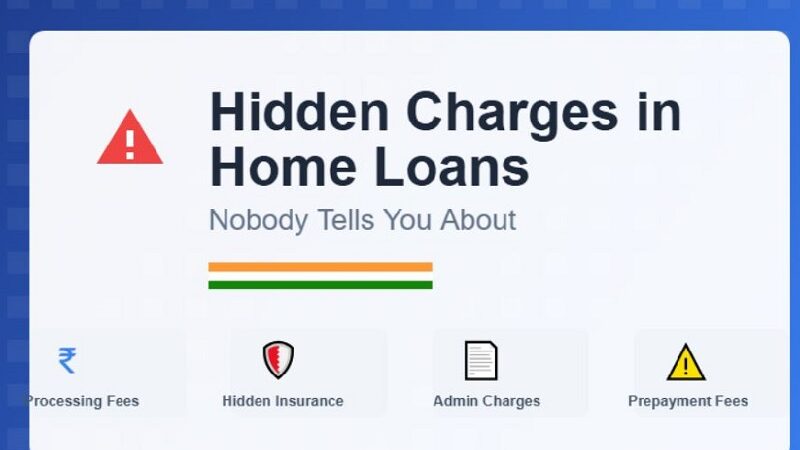
Processing fees, prepayment charges, legal fees, insurance, technical valuation charges, administrative charges—these “small” costs add up. When I took my loan, these extras came to about 2% of my loan amount. Budget for them.
Also check:
- Can you prepay without penalty? (RBI mandates no penalty on floating rate loans)
- What happens if you miss an EMI?
- Are there any hidden charges?
- What’s the reset clause for floating rates?
6. Consider Your Job Stability and Future Plans
Ask yourself honestly:
- Is my job secure?
- Do I plan to change cities in the next 2-3 years?
- Am I planning major life changes (marriage, children, higher education)?
- Can I handle this EMI if my income reduces?
I’ve seen friends get stuck with properties in cities they no longer live in, struggling to rent them out while paying EMIs.
7. Get Pre-Approved
Before you start house hunting, get a pre-approved loan. This gives you:
- Clear budget (you know exactly how much you can spend)
- Negotiating power (sellers take you seriously)
- Faster processing when you find the right property
- Better confidence in your search
Types of Interest Rates: Fixed vs. Floating vs. Hybrid
This is one of the most important decisions you’ll make. Let me break down each type:
Fixed Rate Home Loans
How it works: Your interest rate remains constant throughout the loan tenure, no matter what happens in the market.
Advantages:
- Complete predictability—your EMI never changes
- Perfect for budgeting and financial planning
- Protection against rate hikes (if RBI increases repo rates, your rate stays the same)
- Peace of mind for risk-averse borrowers
Disadvantages:
- Initial rates are typically 1-2% higher than floating rates
- If market rates fall, you’re stuck paying the higher rate unless you refinance
- Most banks charge prepayment penalties on fixed-rate loans (2-3% of outstanding amount)
- Less flexibility—difficult to switch banks
- Very few lenders offer pure fixed-rate loans anymore
Best for: Conservative borrowers who value stability and can’t afford EMI fluctuations. Also good if you’re taking a loan when rates are historically low and expect them to rise.
Floating Rate Home Loans
How it works: Your interest rate changes with market conditions. Rates are typically linked to the RBI’s repo rate or the bank’s MCLR (Marginal Cost of Funds based Lending Rate).
Advantages:
- Usually 1-2% lower than fixed rates initially
- You benefit immediately when RBI cuts rates
- RBI mandates no prepayment penalty on floating rate loans
- More flexibility—easier to switch to another bank (balance transfer)
- Most popular option in India
Disadvantages:
- EMI can increase if interest rates rise
- Uncertainty makes financial planning difficult
- You need to monitor rate changes
Best for: Borrowers comfortable with some uncertainty, those with rising incomes who can absorb fluctuations, and those who plan to prepay aggressively.
My experience: I chose floating and it worked out because rates have been relatively stable. I saved compared to fixed rates and was able to prepay without penalties.
Hybrid Rate Home Loans
How it works: You start with a fixed rate for the first 2-5 years, then the loan automatically converts to floating rate for the remaining tenure.
Advantages:
- Best of both worlds—stability initially, flexibility later
- Good for first-time buyers who want early certainty
- Usually better than pure fixed rates
- No conversion charges
Disadvantages:
- It completely depends on lenders in India actually offer hybrid loans or not
- Limited availability means less choice
- Terms may not be as competitive as standard options
- The fixed portion still has higher rates
Best for: First-time buyers who want predictable EMIs during the initial years while settling into home ownership, then benefit from floating rates later.
Understanding Your Repayment Flow
Let me explain this with a real example because this is where it gets interesting—and often shocking for first-time borrowers.
How Your EMI Actually Works
Say you take a loan of ₹50 lakhs at 9% interest for 20 years. Your EMI would be approximately ₹44,986.
Now here’s the part that shocked me when I first learned it: In the initial years, most of your EMI goes toward interest, not the principal.
Year 1 (₹50 lakh loan @ 9% for 20 years):
- Total paid in 12 months: ₹5,39,832
- Interest component: ₹4,46,247 (83% of your payment!)
- Principal repaid: ₹93,585 (only 17%)
- Outstanding balance: ₹49,06,415
See what I mean? You pay over ₹5.39 lakhs in the first year, but only ₹93,585 goes toward actually reducing your loan! This feels terrible initially.
Year 5:
- Outstanding loan: ₹43,15,240
- Annual interest: ₹3,83,576
- Annual principal: ₹1,56,256
Year 10:
- Outstanding loan: ₹33,44,128
- Annual interest: ₹2,94,303
- Annual principal: ₹2,45,529
- By now, the balance starts shifting
- More of your EMI goes toward principal
- You’re finally making a real dent
Year 15:
- Outstanding loan: ₹19,84,367
- Annual interest: ₹1,73,147
- Annual principal: ₹3,66,685
Year 20 (Final year):
- Most of your EMI goes toward principal
- Very little interest component
- Total paid: approximately ₹1.07 crores
- That’s your ₹50 lakh loan + ₹57.97 lakhs in interest
The Math Behind It:
This isn’t a bank conspiracy—it’s how all reducing balance loans work. In early years:
- Outstanding principal is highest
- So interest (calculated on outstanding amount) is highest
- What’s left after interest goes to principal
As years pass:
- Outstanding principal reduces
- So interest component reduces
- More money goes toward principal
- It’s like a snowball effect in reverse
EMI Calculation Formula:
EMI = P × r × (1 + r)^n / [(1 + r)^n – 1]
Where:
- P = Principal loan amount
- r = Monthly interest rate (annual rate/12/100)
- n = Loan tenure in months
Example:
- P = ₹50,00,000
- Annual rate = 9%, so r = 9/12/100 = 0.0075
- n = 240 months (20 years)
EMI = 50,00,000 × 0.0075 × (1.0075)^240 / [(1.0075)^240 – 1] EMI ≈ ₹44,986
Click here to calculate your EMI
The Power of Prepayment
This is where you can really save money and cut years off your loan. Every time you get a bonus, increment, or unexpected windfall, consider making a partial prepayment.
Scenario: ₹50 lakh loan @ 9% for 20 years
Without prepayment:
- EMI: ₹44,986
- Total interest: ₹57.97 lakhs
- Total repayment: ₹1.07 crores
With prepayment of ₹1 lakh annually from Year 3:
- Same EMI: ₹44,986
- Total interest: ₹42.33 lakhs (saving of ₹15.64 lakhs!)
- Loan closes in: 15 years 8 months (4+ years earlier!)
The Impact of Timing:
An early prepayment has exponentially more impact:
₹1 lakh prepayment in Year 1:
- Saves approximately ₹5.8 lakhs in interest
- Reduces tenure by 2.5 years
₹1 lakh prepayment in Year 10:
- Saves approximately ₹2.1 lakhs in interest
- Reduces tenure by 1 year
₹1 lakh prepayment in Year 15:
- Saves approximately ₹50,000 in interest
- Reduces tenure by 7 months
My Personal Prepayment Strategy:
I started making prepayments of ₹1 lakh annually from Year 2. I would:
- Save my annual bonus
- Put aside Diwali bonus/gifts
- Save tax refunds
- Redirect one-time project incentives
Over 5 years, these prepayments:
- Shaved 4 years off my 20-year tenure
- Saved over ₹8.5 lakhs in interest
- Gave me psychological relief seeing the principal drop
Prepayment Options:
Most banks give you two choices when you prepay:
- Reduce EMI: Keep tenure same, reduce monthly payment
- Reduce Tenure: Keep EMI same, finish loan faster (recommended!)
I always chose option 2. It’s psychologically satisfying to see your loan-free date getting closer.
Tips for Effective Prepayment:
- Do it as early in the loan as possible
- Even ₹20,000-30,000 makes a difference
- Prepay in December/March (after bonuses)
- Keep EMI same, reduce tenure
- Track your savings using prepayment calculators
- Remember: no penalty on floating rate loans!
Final Thoughts:
It’s Not Just Debt—It’s an Investment in Your Future
Yes, you’re taking on debt. But let’s reframe that: you’re forcing yourself to save. Every EMI you pay increases your ownership in an appreciating asset. In 20 years, you’ll own something tangible. Rent payments? They’re gone forever.
I did the math once: If I had continued renting and invested the down payment amount, I would still be behind compared to the equity I’ve built in my home—even after accounting for maintenance costs and interest paid.
Your Home is More Than Numbers
There’s something magical about painting walls the color you want, hanging pictures without worrying about the landlord, letting your kids draw on a wall (yes, really!), and never again hearing “the owner wants the house back.”
That security? You can’t put a price on it.
The Right Time is When You’re Ready—Not When the Market is Perfect
People waste years trying to time the real estate market. “Prices will fall next year.” “Wait for the next budget.” “The market is too high right now.”
Here’s the truth: if you’re financially stable, have a steady income, decent savings, and need a home—now is a good time. Property prices generally trend upward over 10-20 year periods despite short-term fluctuations.
And remember, you’re buying a home, not making a speculative investment. The primary goal is a roof over your head, not timing the market perfectly.
Why are you waiting now? Build your own place
Just comment if you have any query or want to know more