What is Equity Mutual Funds: types, expected returns (12-15%), risks, benefits, best investment time frame, and how to start investing.
Are you looking to invest in equity mutual funds but don’t know where to start? You’re in the right place. This comprehensive guide explains everything about equity mutual fund investment, from how they work to expected returns and risk management strategies.
What Are Equity Mutual Funds?
Equity mutual funds are investment vehicles that pool money from multiple investors to purchase shares of various companies. A professional fund manager handles the investment decisions, making equity funds ideal for beginners and experienced investors alike.
Think of equity mutual funds as a basket of stocks managed by professionals. Instead of picking individual stocks yourself, you invest in a diversified portfolio managed by experts who research markets full-time.
How Do Equity Mutual Funds Work?
When you invest in equity mutual funds:
- Your money combines with thousands of other investors
- A SEBI-registered fund manager invests in carefully selected stocks
- You receive units based on the current Net Asset Value (NAV)
- Your returns depend on the fund’s stock portfolio performance
- You can redeem units anytime (with some exit load considerations)
Types of Equity Mutual Funds in India
Understanding different types of equity mutual funds helps you choose the right investment strategy:
1. Large Cap Equity Funds
Large cap funds invest in India’s top 100 companies by market capitalization. These include established giants like Reliance Industries, TCS, HDFC Bank, and Infosys.
Best for: Conservative equity investors seeking stable returns
Expected Returns: 10-12% annually (long-term)
Risk Level: Moderate
2. Mid Cap Equity Funds
Mid cap mutual funds target companies ranked 101-250 by market cap. These are growth-stage companies with higher return potential than large caps.
Best for: Investors with moderate risk appetite
Expected Returns: 12-15% annually (long-term)
Risk Level: Moderately High
3. Small Cap Equity Funds
Small cap funds invest in companies beyond the top 250. These offer highest growth potential but come with significant volatility.
Best for: Aggressive investors with long investment horizon
Expected Returns: 15-18% annually (long-term)
Risk Level: High
4. Multi Cap or Flexi Cap Funds
Flexi cap funds invest across large, mid, and small cap stocks, giving fund managers flexibility to adapt to market conditions.
Best for: Investors wanting diversification across market caps
Expected Returns: 11-14% annually (long-term)
Risk Level: Moderate to High
5. Sectoral/Thematic Equity Funds
Sectoral funds concentrate on specific industries like technology, banking, pharmaceuticals, or infrastructure.
Best for: Investors with strong sector conviction
Expected Returns: Variable (12-20%)
Risk Level: Very High
6. ELSS (Equity Linked Savings Scheme)
ELSS mutual funds offer tax benefits under Section 80C while investing in equities, with a mandatory 3-year lock-in period.
Best for: Tax-saving investors
Expected Returns: 10-15% annually
Risk Level: Moderate to High
Tax Benefit: Deduction up to ₹1.5 lakh
Key Benefits of Equity Mutual Funds
1. Professional Fund Management
Expert fund managers with years of experience analyze markets, research companies, and make informed investment decisions on your behalf. You don’t need stock market expertise to invest successfully.
2. Diversification Benefits
A single equity mutual fund investment gives you exposure to 30-100+ companies across sectors. This diversification reduces the risk of significant losses from any single company’s poor performance.
3. High Liquidity
Unlike fixed deposits or real estate, equity mutual funds offer high liquidity. You can redeem your units within 2-3 business days (excluding ELSS with 3-year lock-in).
4. Low Minimum Investment
Start your equity mutual fund investment journey with just ₹500 through SIP (Systematic Investment Plan). This makes wealth creation accessible to everyone.
5. Inflation-Beating Returns
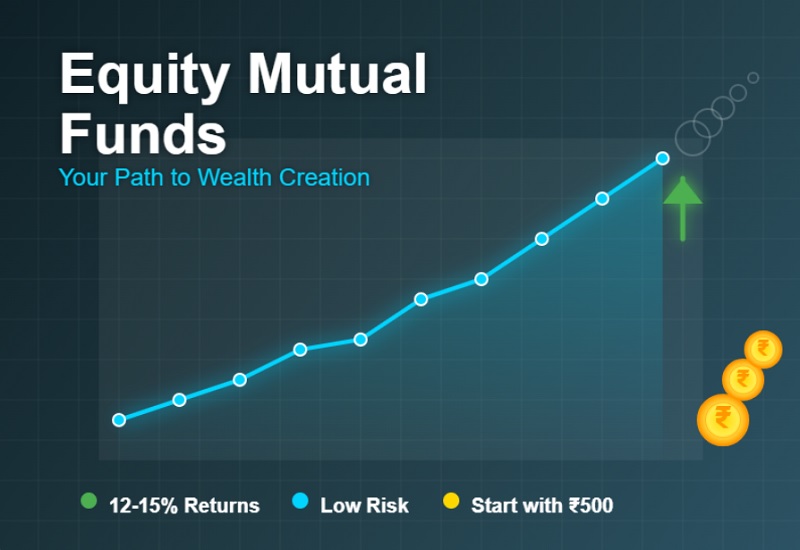
Historical data shows equity mutual funds deliver 12-15% annual returns over long periods, significantly beating inflation rates of 5-6%.
6. Tax Efficiency
Long-term capital gains (LTCG) above ₹1.25 lakh are taxed at just 12.5%. Short-term gains are taxed at 20%. ELSS funds offer additional tax deductions.
7. Transparency and Regulation
SEBI regulates all mutual funds in India, ensuring transparency. You can track your portfolio performance, fund holdings, and NAV daily.
8. Rupee Cost Averaging Through SIP
Systematic Investment Plans (SIPs) help you buy more units when markets fall and fewer when markets rise, averaging your purchase cost over time.
9. Power of Compounding
Long-term equity mutual fund investments benefit from compounding, where your returns generate additional returns, accelerating wealth creation.
Equity Mutual Fund Returns: What to Expect
Historical Returns of Equity Mutual Funds
Let me be honest about equity mutual fund returns—they’re neither guaranteed nor linear.
Long-term Average Returns (10+ years): 12-15% annually
Good Years: 25-40% returns
Bad Years: -10 to -20% returns
5-Year Rolling Returns: 8-18%
Category-Wise Expected Returns
| Fund Category | Expected Annual Returns (Long-term) |
|---|---|
| Large Cap Funds | 10-12% |
| Mid Cap Funds | 12-15% |
| Small Cap Funds | 15-18% |
| Flexi Cap Funds | 11-14% |
| Sectoral Funds | 12-20% (highly variable) |
| ELSS Funds | 10-15% |
Real Returns Example
Consider investing ₹10,000 monthly in equity mutual funds through SIP:
At 12% annual return:
- After 10 years: ₹23.23 lakhs (Invested: ₹12 lakhs)
- After 15 years: ₹50.00 lakhs (Invested: ₹18 lakhs)
- After 20 years: ₹99.91 lakhs (Invested: ₹24 lakhs)
Factors Affecting Equity Fund Returns
- Market Conditions: Bull and bear markets significantly impact returns
- Fund Manager Expertise: Quality of stock selection matters
- Expense Ratio: Lower costs mean higher net returns
- Economic Growth: GDP growth drives corporate profits
- Global Events: Pandemics, wars, recessions affect markets
Risks in Equity Mutual Funds
Every investment carries risk, and equity mutual funds are no exception. Understanding these risks helps you invest wisely.
1. Market Risk (Systematic Risk)
When stock markets decline, equity fund values drop. The 2008 financial crisis, 2020 pandemic crash, and 2022 corrections all hurt equity investors.
Risk Level: High
Mitigation: Long investment horizon, SIP investing
2. Volatility Risk
Equity fund NAVs fluctuate daily. You might see your ₹1 lakh investment become ₹80,000 or ₹1.2 lakhs within months.
Risk Level: High (especially small-cap funds)
Mitigation: Don’t check portfolio daily, focus on long-term goals
3. Concentration Risk
Sectoral funds or portfolios concentrated in few stocks carry higher risk. If that sector underperforms, your entire investment suffers.
Risk Level: Very High in sectoral funds
Mitigation: Choose diversified funds, avoid over-concentration
4. Fund Manager Risk
Poor investment decisions by fund managers can underperform benchmarks. Management changes can also affect fund performance.
Risk Level: Moderate
Mitigation: Review fund performance quarterly, compare with benchmarks
5. Liquidity Risk
While generally liquid, certain small-cap funds during market crashes might face redemption pressures, though this is rare in India.
Risk Level: Low to Moderate
Mitigation: Invest in funds with good AUM and track record
6. Interest Rate Risk
Rising interest rates can make debt instruments more attractive, leading to money flowing out of equity funds.
Risk Level: Moderate
Mitigation: Stay invested through rate cycles
7. Inflation Risk
If your equity fund returns don’t beat inflation, you lose purchasing power despite positive returns.
Risk Level: Low (equity funds historically beat inflation)
Mitigation: Long-term investing in quality funds
8. Exit Load and Tax Implications
Redeeming units within 1 year attracts higher taxes (20% STCG) and possible exit loads (typically 1% if redeemed before 1 year).
Risk Level: Low
Mitigation: Invest with long-term perspective
Time Horizon by Fund Type
| Fund Type | Minimum Horizon | Recommended Horizon |
|---|---|---|
| Large Cap | 5 years | 7-10 years |
| Mid Cap | 7 years | 10+ years |
| Small Cap | 10 years | 15+ years |
| Flexi Cap | 5-7 years | 10+ years |
| ELSS | 3 years (lock-in) | 7-10 years |
| Sectoral | 7-10 years | 10+ years |
Age-Based Equity Allocation
20-30 years old: 80-90% equity allocation
30-40 years old: 70-80% equity allocation
40-50 years old: 60-70% equity allocation
50-60 years old: 40-50% equity allocation
60+ years old: 20-30% equity allocation
Rule of Thumb: 100 minus your age = % in equity (approximate guideline)
Best Equity Mutual Funds to Consider (Categories)
Rather than specific fund names, focus on:
✓ 1-2 Large Cap Funds: For stability
✓ 1-2 Flexi Cap Funds: For balanced growth
✓ 1 Mid Cap Fund: For higher returns (if risk appetite permits)
✓ 1 ELSS Fund: For tax saving
Pro Tip: Don’t invest in more than 5-6 equity funds. Over-diversification dilutes returns.
Mistakes to Avoid
- Investing without goals: Know WHY you’re investing
- Stopping SIP during market falls: This is the best time to accumulate
- Chasing last year’s top performers: Past performance doesn’t guarantee future returns
- Investing for short term: Recipe for disappointment
- No portfolio review: Review quarterly, rebalance annually
- Emotional decisions: Don’t panic-sell or greed-buy
- Ignoring expense ratios: Higher costs eat into returns
Frequently Asked Questions
1. Are equity mutual funds safe?
Equity mutual funds carry market risk and aren’t “safe” in traditional sense. However, long-term investing (7+ years) with diversified funds significantly reduces risk. They’re safer than individual stock picking due to diversification.
2. What is the minimum amount to invest in equity mutual funds?
You can start with just ₹500 monthly through SIP in most equity mutual funds. Some funds allow even ₹100 SIPs.
3. Which is better: SIP or lump sum in equity funds?
SIP is better for most investors because it:
- Removes market timing concerns
- Builds discipline
- Averages purchase cost
- Reduces stress
Lump sum works if you have market expertise and investable surplus during market corrections.
4. How much return can I expect from equity mutual funds?
Realistically expect 12-15% annual returns over 10+ years. Some years you’ll get 30%, others -10%. Focus on long-term average, not yearly fluctuations.
5. What is the best time to invest in equity mutual funds?
NOW. Time in the market beats timing the market. If starting with SIP, any time is good. For lump sum, market corrections offer better entry points, but predicting them is difficult.
6. Should I invest in direct or regular plans?
Direct plans have lower expense ratios (0.5-1% lower) and generate higher returns over time. Invest direct if you can research and select funds yourself. Choose regular plans if you need advisor guidance.
7. How many equity mutual funds should I invest in?
4-6 funds across categories is optimal. Over-diversification (10+ funds) creates tracking difficulty and dilutes returns.
8. Can I lose money in equity mutual funds?
Yes, especially if you invest short-term or panic-sell during market falls. However, history shows long-term equity investors (10+ years) rarely lose money and typically earn inflation-beating returns.
9. What is expense ratio in mutual funds?
Expense ratio is the annual fee charged by AMCs for fund management. Lower is better. Direct plans have 0.5-1% lower expense ratios than regular plans. Even 1% difference compounds to lakhs over decades.
10. When should I exit from equity mutual funds?
Exit only when:
- You achieve your financial goal
- Fund consistently underperforms benchmark for 2+ years
- Fund manager changes and new manager has poor track record
- Your risk profile changes (nearing retirement)
Don’t exit during temporary market corrections.
Final Thoughts: Your Equity Mutual Fund Journey
After years of observing investors (and making my own mistakes), I’ve learned that success with equity mutual funds isn’t about finding the “perfect” fund or timing markets flawlessly.
It’s about:
✓ Starting early (even with small amounts)
✓ Investing regularly through SIPs
✓ Staying patient during market storms
✓ Letting time and compounding work their magic
✓ Keeping emotions in check
The biggest investment mistake isn’t choosing wrong funds—it’s never starting at all because you’re waiting for the “right time.”
There’s wisdom in the saying: “Time in the market beats timing the market.” It’s become a cliché because it’s proven true across decades and continents.
Remember, equity mutual fund investing is a marathon, not a sprint. The tortoise wins this race, not the hare.